New Fourth-Generation Hyundai i20 Unveiled: Bolder Design, Bigger Cabin, and a Big Question for India
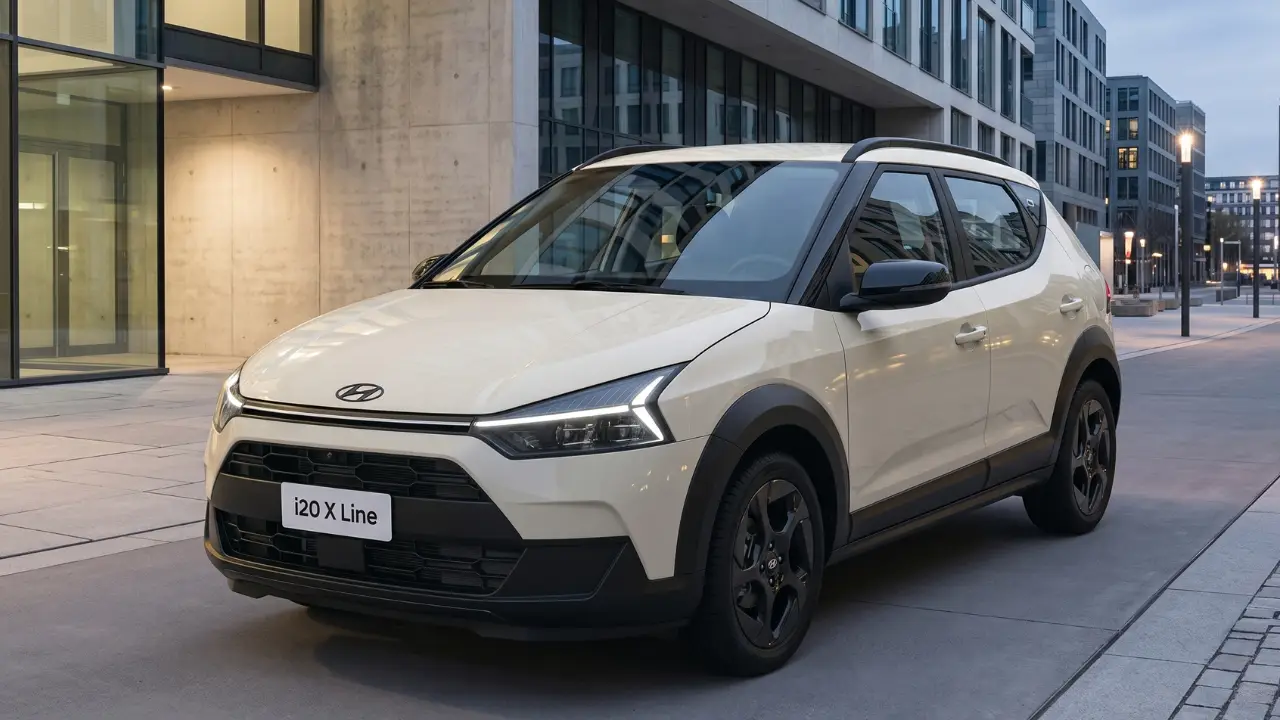
When I first saw the reveal images of the fourth-generation Hyundai i20, my honest reaction was: “Wait, did Hyundai accidentally show me the Venue’s younger sibling?” That upright stance, the black plastic cladding on the wheel arches, the taller overall profile. This is not the sharp, low-slung premium hatch we knew from 2020. Hyundai has taken a deliberate turn with this car, and it is going to divide opinion sharply among loyal i20 buyers. So let me break it down properly, from the outside in, and then talk about what it actually means if you are sitting in India deciding your next car purchase.
Exterior Design: How the Fourth-Generation Hyundai i20 Looks on the Road
Let me start with the obvious: this car looks polarizing in photos, but probably commands more road presence in person than the third-gen ever did.
The front end gets a full-width connected LED light bar, Y-shaped DRLs, and dual-pod pixel-style LED headlights. The grille carries honeycomb elements and has a radar sensor integrated into the bumper for the ADAS system. It is a busy face, but it reads as premium rather than cheap. Hyundai clearly knows how to design a front fascia that catches attention in traffic.
From the side, the surfacing is actually cleaner than the outgoing model. Fewer creases, a distinctive kink in the window line, and 17-inch dual-tone alloy wheels that fill the arches properly. No awkward gap between tyre and arch that budget cars often suffer from. The sleek ORVMs sit flush and add to that tidy side profile.
The rear continues the connected light bar theme, this time linking C-shaped taillights across the full width. There is a protruding tailgate element, a faux diffuser on the black bumper, and a shark-fin antenna on the roof. My personal concern: that faux diffuser on the lower bumper is going to take punishment on flooded Mumbai streets and speed breakers in smaller cities. Style points, minus a few durability points.
Also Read: Skoda Kylaq Review: The Best Sub-4m SUV for Delhi Roads Right Now?
Ground clearance sits at 165 mm. That is not Creta territory, but it is meaningfully better than what the current India-spec i20 offers. Monsoon-season confidence will improve.
Dimensions have grown noticeably. The new body stretches to approximately 4,130 mm in length, up from the 3,995 mm of the current India model. That extra 135 mm is not just cosmetic. You feel it in the rear seat and in the boot.
Cabin Comfort, Space, and Tech: Where the Fourth-Generation Hyundai i20 Gets Serious
Step inside and the shift feels even more dramatic than the exterior. The cabin has gone properly upscale. Dual-tone beige and grey with soft-touch materials on the surfaces you actually touch. No hard plastic where your arm rests. This is the kind of interior finish that made people pay a premium for the i20 in the first place, and Hyundai has upgraded it further here.
The star of the dashboard is the panoramic curved dual-screen setup: a 10.25-inch digital instrument cluster paired with a 12.3-inch touchscreen infotainment system. Now, I know what you are thinking. A 12.3-inch screen sounds great in a press release, but how does it behave at 2 PM on an Indian highway with the sun hammering down? Hyundai’s screen calibration on recent models has been decent in terms of brightness and anti-glare. The Creta’s unit holds up reasonably well in sunlight, and this should be at least on par.
The three-spoke steering wheel gets an illuminated Morse-code ‘H’ logo and paddle shifters. The vertically oriented center console uses touch-enabled AC controls with a rotary fan knob. Crucially, physical buttons are retained for key functions. This matters. Nothing tests your patience like hunting through three menu layers to adjust the fan speed while navigating a busy intersection.
Wireless Android Auto and Apple CarPlay come on board, which means no fumbling with cables every time you get in the car.
Rear seat space benefits from the longer wheelbase. The 60:40 split folding rear bench adds practical flexibility. And the boot: 346 litres of usable cargo space, up from 311 litres on the current India model.
To put that number in real terms: a family of four heading to Coorg or Shimla for a four-day weekend needs roughly two large trolley bags and two medium cabin bags. At 346 litres, you fit all of that without folding the rear seats. That is genuinely useful for the target buyer of this car.
| Feature | Real-World Impact for Indian Buyers |
|---|---|
| 12.3-inch touchscreen infotainment | Easy navigation and media control; good visibility in bright sunlight |
| 10.25-inch digital instrument cluster | Clean, fatigue-free readout on long highway drives |
| Wireless Android Auto / Apple CarPlay | No cable clutter; phone syncs automatically on entry |
| Semi-leatherette seats | Easier to clean after a road trip; cooler than fabric in summer |
| 60:40 split rear seats | Carry long items or weekend luggage with one passenger still seated |
| 346-litre boot space | Fits four-day family trip luggage without touching the rear seats |
| Physical AC and fan controls | No fumbling through menus in traffic |
| Six airbags (higher trims) | Meaningful passive safety across the cabin |
| ADAS suite with forward collision warning | Active safety layer for highway driving |
Sunroof availability is not confirmed in the Brazil-market launch images. For India, where a sunroof is practically a buying criterion for this segment, that will need to be clarified before the car arrives here.
Engine Performance and Driving Dynamics
Two engines are confirmed. The 1.2-litre naturally aspirated petrol puts out 83 to 88 PS and pairs with a manual or IVT. This is the bread-and-butter unit: smooth, fuel-efficient, suited to city commuting and occasional highway use. It is not exciting, but it is reliable and familiar.
The more interesting choice is the 1.0-litre turbocharged TGDi, producing 100 to 120 PS depending on the market, mated to a manual or DCT. The TGDi badge has been confirmed in reveal imagery. This engine in the current i20 already made the car noticeably more alive on the expressway. Overtaking at 100 kmph stops being a prayer with the turbo under the hood.
Also Read: Renault Duster 1.0 MT 2026 Real-World Review: Best Value Manual Midsize SUV Under ₹14 Lakh?
Suspension tuning is reported to be on the stiffer side in certain variants. My honest take: stiffer suspension works well for highway-biased buyers in metros, but for anyone in Kolkata or Lucknow dealing with uneven city roads daily, that firmness will be felt. I would strongly recommend a proper test drive on your city’s actual roads before deciding.
No hybrid or full EV variant is confirmed for this generation at launch.
The Indian Market Context and the Hatchback vs Crossover Dilemma
Here is the uncomfortable truth Hyundai is navigating. The premium hatchback segment in India is not what it was five years ago. Buyers who would have bought an i20 at Rs 10 to 12 lakh in 2020 are now seriously cross-shopping the Nexon, Punch, and Brezza. The segment is being squeezed from below by value hatches and from above by affordable compact SUVs.
The fourth-generation i20’s crossover styling is Hyundai’s answer to that squeeze. By making the car look taller and more muscular, they hope to capture buyers who want SUV presence without the SUV price tag.
How does it stack up against the actual competition?
Against the Maruti Suzuki Baleno, the i20 offers a richer cabin, better safety hardware, and more feature density. The Baleno’s advantage remains Maruti’s unbeatable service network across India. In a smaller city, getting Hyundai service support takes more effort than finding a Maruti workshop.
Against the Tata Altroz, the i20 wins on infotainment features and interior quality. But the Altroz carries a 5-star Global NCAP score, which is still a powerful sales argument for safety-conscious families. Hyundai will need to show equally strong crash test results for the new model.
Against the Toyota Glanza, which shares the Baleno platform, the i20 is simply a more evolved product with more distinctive design and better feature loading.
Hyundai has not confirmed an India launch date for the fourth-generation i20. The initial production is Brazil-first. Whether it arrives here unchanged, modified for local tastes, or replaces the current model on a different timeline, remains to be seen.
Final Verdict: Who Should Buy the Fourth-Generation Hyundai i20?
If you are in the market for a car priced around Rs 8 to 12 lakh and you want a cabin that feels genuinely premium, a practical family-sized boot, solid active and passive safety, and the option of a punchy turbocharged engine, the new i20 is a strong candidate. The crossover styling is a shift, but the core promise of being the most feature-rich car in the segment remains intact.
If you wanted the sporty, taut-looking premium hatch that the third-gen represented, this is a different car. I personally preferred the sharpness of the 2020 model’s design. But I also understand that Hyundai is building for where the market is going, not where it was.
Wait for the official India launch pricing and a proper local test drive before booking. Especially check how the suspension behaves on your city’s roads. The spec sheet looks good. The road tells the real story.
So here is the question I want to leave you with: does the fourth-generation Hyundai i20’s crossover makeover make you more likely to buy it, or do you feel Hyundai should have stayed true to the classic premium hatchback formula? Tell me in the comments.