Suzuki Swift Hydrogen Unveiled: The New H2 ICE That Changes Everything We Thought About Small Cars
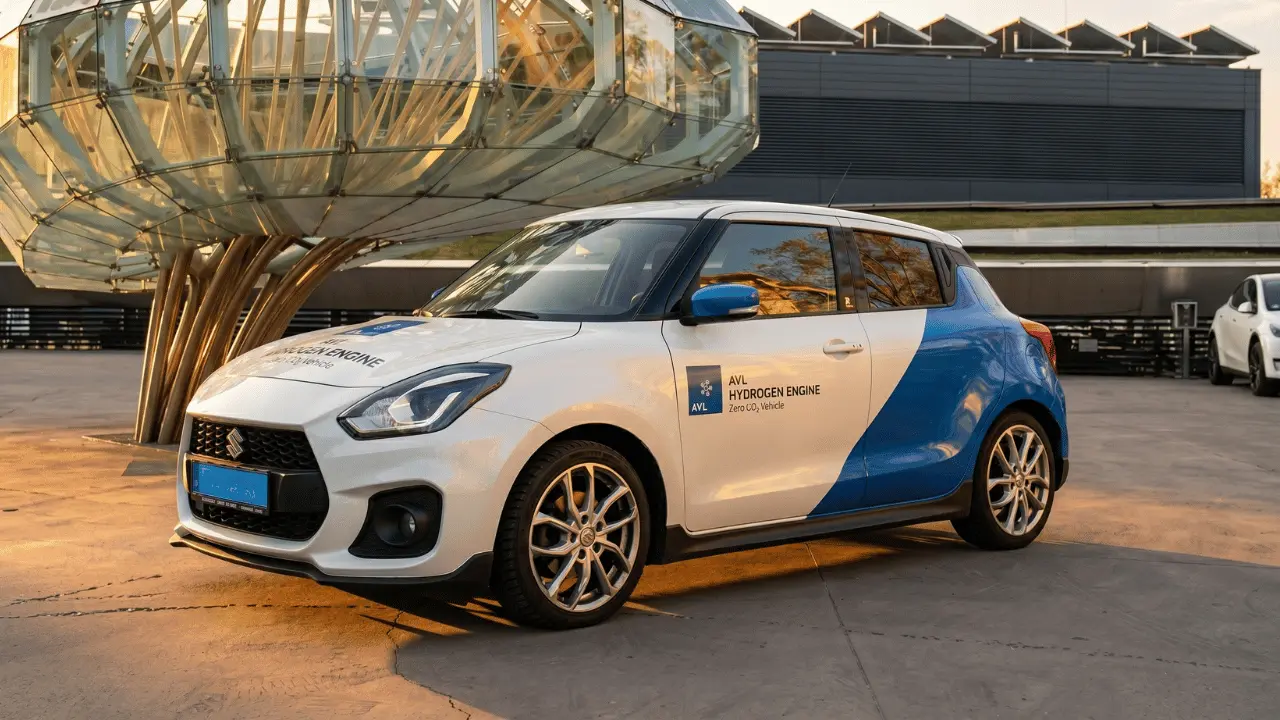
If you thought the future of the Maruti Suzuki Swift was going fully electric, Suzuki just threw a massive curveball at the 2026 Vienna Motor Symposium. The Suzuki Swift Hydrogen prototype doesn’t run on a battery pack or a fuel cell — it burns hydrogen directly in a combustion chamber, pushes out 100 kW and 220 Nm, and emits little more than water vapor. That’s not a concept. That’s a working engine, built with AVL, ready to be taken seriously.
What the Suzuki Swift Hydrogen Actually Is (And What It Isn’t)
Let’s clear this up first, because the terminology matters here.
Most people hear “hydrogen car” and immediately picture something like the Toyota Mirai — a Hydrogen Fuel Cell Electric Vehicle (FCEV) that uses a chemical reaction to generate electricity. The Swift Hydrogen is nothing like that. It uses a Hydrogen Internal Combustion Engine (H2 ICE), meaning hydrogen gets injected directly into a combustion chamber and burned, just like petrol does in a conventional engine.
The key difference? No heavy fuel cell stack. No expensive battery chemistry. Just a modified 1.4-litre four-cylinder — co-developed with Austrian engineering firm AVL — that happens to run clean.
That distinction isn’t just technical trivia. It’s the entire reason this prototype is worth your attention.
Engine Specs That Actually Impress
The H2 ICE has two operating modes, and both are genuinely capable for a car this size.
In Lean Mode, the engine delivers 90 kW and 200 Nm — solid numbers for a compact hatchback doing everyday city and highway duty. Push it into Stoichiometric (Lambda=1) Mode and you’re looking at 100 kW (around 135 hp) and 220 Nm of torque. That’s more than enough to give the Swift its signature punchy, responsive feel.
To keep nitrogen oxide (NOx) emissions under control — a real concern with hydrogen combustion at high temperatures — Suzuki fitted a cooled Exhaust Gas Recirculation (EGR) system. It’s not just clean on paper. It’s engineered to stay clean in actual driving conditions.
Why H2 ICE Makes Far More Sense Than an EV for This Segment
Here’s an honest take: cramming a large battery pack into a compact hatchback has always been a compromise. It adds weight, kills the handling balance, pushes the price up, and fundamentally changes what the car is.
The Swift’s identity is built around being lightweight, affordable, and fun. A hydrogen ICE protects all three of those things.
Manufacturing costs stay manageable because you’re adapting existing combustion architecture rather than building an entirely new electric platform. The car stays light. And refueling takes minutes — not the 30-to-45 minute charging stops that remain one of the biggest real-world friction points with EVs.
This isn’t anti-EV thinking. It’s pragmatic engineering for a specific type of car and a specific type of buyer.
What This Actually Means for India
Let’s talk about what this means for our roads specifically.
Maruti Suzuki dominates the Indian market, and the Swift is practically a household name here. The Indian government is already aggressively pushing the National Green Hydrogen Mission, with targets to set up refueling stations every 200 km along major transport corridors by 2030.
Drop a production-ready H2 ICE Swift into that roadmap, and it’s not a science experiment anymore. It’s a realistic look at what a lot of us could be driving by 2028 or so. More importantly, it proves that going green in this segment doesn’t have to mean sacrificing the lightweight, punchy character that made the Swift worth buying in the first place.
Also Read: Mahindra Vision S EV (2026): Launch Date, Expected Price & Real-World Range
Who Should Be Watching This Closely
Anyone who drives a compact hatchback and has real, practical hesitations about switching to a pure EV — charging infrastructure, range anxiety, upfront costs — the Swift Hydrogen prototype is being engineered with exactly that kind of buyer in mind.
Fleet operators in urban markets, government agencies with clean-transport mandates, and anyone living in a city where hydrogen infrastructure is being actively built out should be tracking this development closely.
It’s also worth watching for what it signals about Suzuki’s broader strategy. This isn’t a one-off stunt. It’s a deliberate engineering investment in an alternative path to zero emissions.
Timeline: When Does This Reach Showrooms?
As of May 2026, the Swift Hydrogen is still a technology demonstrator. A commercial launch isn’t happening before 2028 at the earliest, and the timeline is tied directly to how quickly hydrogen refueling networks expand.
But here’s the thing: the engineering is clearly mature. Suzuki didn’t just sketch a concept — they built a working prototype with a real industrial partner and real performance numbers. The bottleneck now is infrastructure, not the car itself.
That’s actually an optimistic place to be.
Also Read: New Honda City Facelift 2026: Complete Guide to Features, Price, and Launch Date
The internal combustion engine isn’t dying. It’s changing what it eats. The Suzuki Swift Hydrogen makes a genuinely strong case that clean, affordable, fun-to-drive compact cars don’t have to follow the battery-electric playbook to have a future.
So — are you more excited by the H2 ICE route, or do you still think battery-electric is the smarter long-term bet for a car like the Swift?