New Tata Tiago EV Facelift 2026: Complete Guide to Specs, Price, Features & Should You Wait?
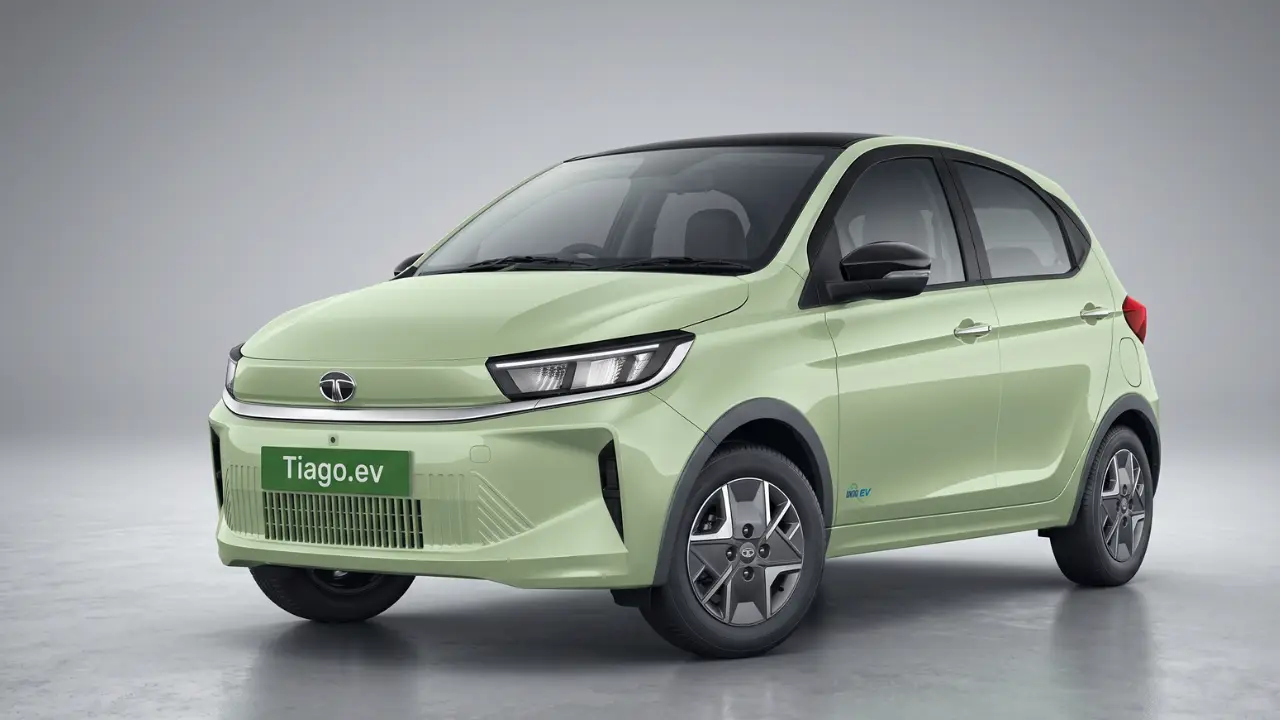
If you’ve been avoiding the current Tiago EV because it looks a bit too much like a 2019 budget hatchback repackaged as an electric car, your patience is finally being rewarded. Tata is launching the Tata Tiago EV facelift 2026 on 28 May 2026, just seven days from now, and from what the teasers show, this is a proper redesign. Not just a new grille and some badges.
The cabin gets a real upgrade too. And there’s a 360-degree camera, which honestly nobody expected at this price point. More on that below.
Launch Date & Current Tiago EV Prices
Tata has officially confirmed 28 May 2026 as the launch date for both the petrol Tiago facelift and the Tiago EV facelift together. Full pricing, variant breakdown, and confirmed specs are only coming on that day, so anything before 28 May is still pre-launch information.
Right now, the pre-facelift Tiago EV is available between ₹7.99 lakh and ₹11.14 lakh ex-showroom. If you’re in Kolkata, on-road pricing starts around ₹8.4 lakh for the base variant and stretches to ₹12 lakh-plus for the top trim once you factor in insurance and registration.
What Tata Will Announce on 28 May 2026
Full variant-wise pricing for both EV and petrol versions. Confirmed battery specs and official range figures. Whether BaaS (Battery-as-a-Service) will be available, which could significantly drop the upfront cost.
Tata Tiago EV Facelift 2026: Design and Feature Upgrades
The front end is the biggest visual change. Slim LED headlamps, a reshaped bumper, and a blanked-out front fascia on the EV give it that clean, modern electric car look instead of the “petrol hatchback with a charge port” feel of the old model. At the back, connected LED taillamps and new dual-tone alloy wheels with aero elements complete the refresh.
New colours are also coming, including coral orange and mint green. For buyers who’ve always thought the Tiago EV only came in boring shades, this is welcome news.
Now, the interior. A larger touchscreen, around 10.25 inches, with wireless Android Auto and Apple CarPlay replaces the older unit. A free-standing digital instrument cluster is also coming in. But the real talking point is the 360-degree camera. Getting this feature under ₹10 lakh is genuinely surprising. Anyone who’s tried parking near Gariahat market on a Saturday evening knows exactly why this matters.
Auto climate control is expected across trims, and higher variants may get wireless charging. On safety, 6 airbags as standard is a big improvement over the older setup, along with ESP, TPMS, hill hold, and ISOFIX mounts.
Also Read: Hyundai Creta EV: The Complete Guide to India’s Most Practical Electric SUV (2026 Update)
Tata Tiago EV Facelift 2026: Battery and Real-World Range
Tata is holding official powertrain details for launch day. Currently, the Tiago EV runs on two battery options: a 19.2 kWh Medium Range pack with a claimed 223 km range, and a 24 kWh Long Range pack claiming 293 km. Real-world? Based on actual user data and independent tests, you’re looking at 140-170 km for MR and 180-220 km for LR in mixed driving. That’s roughly 65-75% of the MIDC claim, which is consistent across most EVs in India.
There are strong rumours that Tata is packing a larger 30 kWh battery into at least the top trims, similar to the Punch EV. Even without that, a more efficient motor or better battery management alone could push the LR variant’s real-world city range past 230 km, which is the point where range anxiety basically disappears for most daily commuters.
Both variants support DC fast charging. The 0-60 km/h sprint takes around 5.7 to 6.2 seconds, which sounds ordinary on paper but feels very lively in stop-and-go city traffic thanks to instant torque delivery.
Expected Price: Tata Tiago EV Facelift 2026
With the design and feature upgrades added, a small price increase over the current model makes sense. Pre-launch estimates put the starting price around ₹8 to ₹8.2 lakh ex-showroom, with top variants going up to ₹11.5 lakh or slightly above.
For Kolkata buyers, base variant on-road should come in around ₹8.5 lakh. It is also worth checking West Bengal state EV incentives at the time of purchase, since those can occasionally change the math in your favour.
If BaaS gets confirmed, the upfront cost drops sharply because the battery is excluded from the vehicle price. That is a genuinely different buying proposition, though the monthly battery subscription cost needs to be calculated against your actual usage before committing.
Tata Tiago EV vs Rivals: How It Compares
| Aspect | Tata Tiago EV (Facelift) | MG Comet EV | Citroen eC3 |
|---|---|---|---|
| Starting Price | ~₹8 lakh | Lower (micro-EV) | Higher |
| Seating | Proper 5-seater | 2+2 (tight rear) | 5-seater |
| Real-world Range | 180-220 km (LR) | ~150-180 km | Competitive |
| Boot Space | Good | Very limited | Better |
| Drive Feel | Peppy and balanced | Nimble city car | Comfort-focused |
| Service Network | Excellent (Tata) | Growing | Limited |
| Features (2026) | 360 cam, digital cluster | Stylish but basic | Decent |
The MG Comet is a good pick if you only need a two-person city runabout and want something cheaper upfront. The eC3 has slightly better interior space but costs more and the service network outside metro cities is genuinely thin. For a family needing a proper 5-seater with a usable boot, the Tiago EV facelift is the practical answer here.
Also Read: Maruti Suzuki eVX 2026: The Complete Guide to India’s Best New Electric SUV
Pros & Cons: Tata Tiago EV Facelift 2026
The good stuff is clear: running costs around ₹1 to ₹1.5 per km, snappy city acceleration thanks to instant torque, a 360-degree camera that no competitor offers at this price, and 6 airbags now standard. Tata’s service network across India is a real advantage too, especially outside big cities where MG and Citroen dealers are scarce.
The honest limitation is range on highway drives. Don’t plan an unplanned 300 km trip and expect to arrive without at least one charging stop and some mild stress. Public fast-chargers are getting better but infrastructure outside major highways is still patchy. For daily city use with home charging though, this is a non-issue.
Pros
- ~₹1-1.5 per km running cost
- Instant torque, fun city drive
- 360-degree camera under ₹10 lakh
- 6 airbags standard across trims
- Tata’s pan-India service network
- Compact size for Indian traffic
Cons
- Highway range needs planning
- Public fast-chargers still thin
- BaaS adds monthly running cost
- Final specs only on 28 May
Total Cost of Ownership: 5-Year Picture
This is where the EV argument really solidifies. A petrol hatchback doing 50 km a day over 5 years will spend somewhere between ₹5.5 to ₹6 lakh just on fuel. The Tiago EV LR doing the same distance on home charging costs roughly ₹1.1 lakh in electricity. That is not a small difference.
Rough 5-Year TCO Comparison (Tiago EV LR vs Petrol Hatchback, ~50 km/day)
Electricity cost (EV) over 5 years~₹1.1 lakh
Petrol cost (petrol hatchback) over 5 years~₹5.5-6 lakh
EV servicing savings (fewer moving parts)~₹30-40K
Estimated 5-year fuel saving with EV₹4.5-5 lakh+
You save roughly ₹4.5 to ₹5 lakh on running costs over five years. That covers most or all of the higher upfront price. The numbers speak for themselves.
Who Should Actually Buy the Tata Tiago EV Facelift 2026?
If you drive 30 to 60 km a day inside a city and can plug in at home overnight, this car is built for your routine. First-time EV buyers who want reliable brand backing will find Tata a lower-risk choice than alternatives with thinner service networks.
Small families needing 5 seats and a decent boot within a ₹12 lakh on-road budget are the core audience here. In Kolkata specifically, the compact footprint handles tight lanes and the stop-start traffic of areas like Park Street or Ultadanga without any drama. The monsoon is a valid concern for EV buyers and Tata’s IP-rated battery packs have a solid track record in Indian monsoon conditions.
If you do regular highway trips of 250 km or more without access to a fast charger at your destination, the range limitation is real and should factor into your decision. For 80 to 90 percent of typical Indian city driving patterns, it’s a non-issue.
Indian Market and Why the Tiago EV Facelift 2026 Matters
Tata Motors has sold hundreds of thousands of EVs in India and remains the clear segment leader. The Tiago EV sits at the most critical price point for mass EV adoption, the sub-₹12 lakh on-road range where the average Indian family actually shops. The facelift keeps Tata competitive here while rivals are still trying to match the feature set and service network.
India’s EV market has been growing at a strong double-digit pace and the affordable segment is what’s actually driving volumes. The Punch EV and Nexon EV handle higher budgets, but the Tiago EV is where Tata reaches first-time buyers. That’s a segment worth getting right, and this facelift suggests Tata knows it.
My Take on the Tata Tiago EV Facelift 2026
The old Tiago EV was a solid car let down by a design that looked dated fairly quickly and a cabin that felt bare next to newer options. The 2026 facelift fixes both. Sharper looks, a proper touchscreen, digital cluster, 360-degree camera, and 6 airbags standard. These aren’t minor tweaks.
Since 28 May is only seven days away, hold off on booking the current model. Wait for confirmed pricing and the full variant list. If BaaS gets announced, the entry cost calculus changes significantly. And if Tata confirms the larger battery option, the top variants become even more compelling.
For city use with home charging, the Tiago EV was already a sensible buy. The facelift makes that case easier to make without having to defend the looks or the feature list.
FAQ: Tata Tiago EV Facelift 2026
When does the Tata Tiago EV facelift 2026 launch?
28 May 2026. Tata confirmed this officially. Full pricing, specs, and variant details will be announced on that day.
What is the expected starting price in Kolkata?
Pre-launch estimates put ex-showroom pricing around ₹8 to ₹8.2 lakh, which means on-road in Kolkata should start around ₹8.5 lakh for the base variant. Confirm exact on-road price after 28 May.
Is the real-world range enough for daily Kolkata commuting?
For most people, yes. The LR battery delivers around 180-220 km in real conditions. If you charge at home and your daily commute is under 80 km, range is not going to be your problem.
Should I book the current model or wait for the facelift?
Wait. The launch is 7 days away. Buying now means paying the same or similar money for an older design and fewer features. There is no good reason not to hold on until 28 May.
Are you planning to book the Tiago EV facelift after the 28 May launch, or are you still weighing EVs against petrol for your situation?