Ferrari Luce: Ferrari’s First Electric Car Is Here, and It’s… a Lot to Process
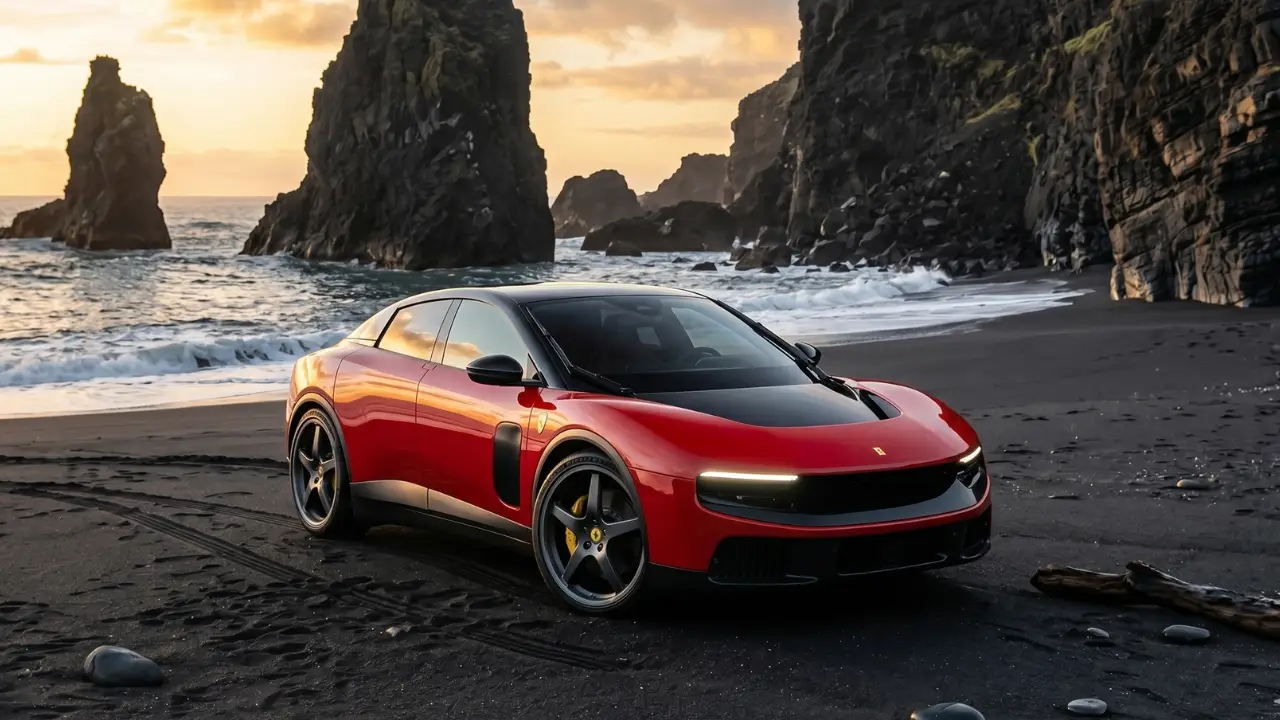
So Ferrari finally did it. On May 25, 2026, they unveiled the Luce (Type F222) in Rome. First fully electric Ferrari. First five-seater Ferrari. First Ferrari that looks like… well, we’ll get to that.
I’ve been staring at the specs and the photos for a day now, and I still haven’t fully made up my mind. But let me break this down properly, because there’s a lot going on here.
What Even Is This Car?
Luce means “light” in Italian. It’s a four-door liftback sedan with five seats. Five seats. In a Ferrari.
That one line is going to cause more pub fights among petrolheads than anything Ferrari has done in the last decade. But here’s the thing: Ferrari isn’t trying to go mass market with this. The entire car, platform, motors, battery, software, all of it built in-house at their new E-Building in Maranello. No supplier parts being rebadged. No shortcuts. They’ve taken electrification seriously in a way that should shut down at least some of the cynics.
The Performance Numbers Are Actually Bonkers
Let me just put them out here.
Four independent motors. One per wheel. Combined output in boost mode: over 1,035 to 1,050 horsepower. Zero to 100 km/h in 2.5 seconds. Top speed 310 km/h.
That’s not “good for an EV.” Those are supercar numbers, full stop.
The battery is a 122 kWh unit on 800V architecture. DC fast charging up to 350 kW. WLTP range claimed at over 530 km. And here’s a detail that genuinely impressed me: the thermal management system can absorb up to 500 kW during sustained performance driving without thermal throttling. That means actual track use, not just one hot lap before the battery babysitter kicks in.
The body is 75% recycled aluminum and the drag coefficient is Cd 0.25, lowest in Ferrari history. The car weighs around 2,260 kg, which is a lot. No getting around that.
The Interior Is Where Things Get Actually Interesting
The exterior has caused some drama. I’ll come to that.
But the inside of this car is doing something genuinely different, and it goes against everything happening in luxury EVs right now. Most manufacturers are just throwing bigger screens at the dashboard and calling it innovation. Ferrari went the opposite way.
Physical buttons. Mechanical switches. Proper dials. There’s an aluminum speedometer with an actual needle, lit by 15 LEDs.
The headline is the dashboard display, which Ferrari developed with Samsung. They’ve used Samsung’s HIAA technology (Hole in Active Area), which comes from smartphone screen development, and for the first time in any car ever, they’ve integrated a high-resolution OLED display with real, physical, moving mechanical hands on top of it. Not a simulation. Actual hands, moving over a live screen.
That’s not a gimmick. That’s legitimately novel engineering. The automotive and consumer tech worlds are talking about this for a reason.
Sound inside comes from synthesized electro-mechanical vibrations pulled from the axles themselves, equalized and amplified. In the sportier modes with paddle-operated torque shifting, it apparently creates driver feedback that feels deliberate rather than manufactured. I obviously haven’t driven it, so I’ll believe it when reviews come in.
Right, the Exterior
Here’s where I’ll give you the honest picture.
My feed has been split completely down the middle. Half the people are calling it futuristic and elegant. The other half are comparing it to a large Nissan Leaf. I’ve seen both reactions, and I get both reactions.
My take: the purists are probably overreacting. Ferrari making a five-seater EV liftback was always going to look like a five-seater EV liftback. What did anyone expect, a Testarossa silhouette with four doors? But I also won’t pretend the design is universally beloved. This argument will run for a long time.
Price: The European Numbers and the Indian Reality
European base price is €5,50,000. That’s roughly $640,000 to $645,000 USD. Fully loaded examples will go higher, obviously.
For Indian buyers, here’s the actual situation. This arrives as a CBU import. India’s customs duties on CBUs exceed 100% before you even add cess. Realistic ex-showroom price in India: ₹12 Crore to ₹14 Crore. On-road in Delhi or Mumbai, after registration, taxes, and insurance, you’re well past ₹15 Crore for most configurations.
European deliveries start late 2026. India gets it in 2027 to 2028.
How It Stacks Up Against Competitors
On raw numbers, the Luce beats the Porsche Taycan Turbo S on top speed and battery capacity, and supports faster charging. The Lucid Air has more range, but it doesn’t have the Ferrari badge or anything close to the performance character.
What no one else is offering is this specific combination: Italian supercar heritage, a driver-first physical interface, the Samsung OLED-plus-mechanical-hands dashboard innovation, and four-motor torque vectoring. As a package, it sits alone in its segment.
Also Read: New Hero Karizma XMR 250: The Most Powerful 250cc Sportsbike India Has Been Waiting For
Who Actually Buys This in India?
The realistic buyer here is a fairly specific person. Existing Ferrari collectors who want the latest from Maranello and aren’t going to miss a launch. Performance enthusiasts who want genuine track-capable hardware in a car they can use daily with a family, which the five-seat layout actually enables. And buyers who want the Ferrari experience but prefer to step away from the running costs and emissions profile of a high-output V8 or V12.
India’s ultra-HNI segment already collects Lamborghinis, Rolls-Royces, and traditional Ferraris. The audience for this car is small but it’s real.
The Practical Concerns Worth Mentioning
Fast charging at 350 kW is great on paper. Outside the major metros, that infrastructure barely exists in India yet. Residual values for first-generation ultra-luxury EVs are genuinely unknown at this point. And at ₹12 to ₹14 Crore ex-showroom, this is not a casual decision even for buyers at that level.
Ferrari has committed to what they’re calling “Ferrari is Forever” support for high-voltage components, which is a reasonable reassurance. The real proof comes when Europeans start driving these in late 2026 and the reviews land.
My Honest Take
Ferrari has made a smart move by keeping everything in-house, rejecting the screen wall interior trend, and doing something genuinely new with the Samsung dashboard technology. They’ve built a Ferrari that happens to be an EV, not an EV that happens to wear a Ferrari badge. That difference matters.
The weight is real. The exterior is divisive. The India price is eye-watering. But the engineering ambition here is serious, the interior direction is refreshing, and anyone paying attention to where automotive design is heading should look closely at that HIAA dashboard.
Whether this becomes a beloved part of Ferrari’s story or just a controversial footnote depends entirely on one thing: how it feels on a twisty road with the pedal properly down. No spec sheet answers that. We find out in 2027.
Are you excited about the Luce, or do you think Ferrari should have kept making combustion engines for a few more years? Let me know in the comments.